Why Do Brands Only Like the Joke After Someone Else Makes It?
- Alex Pinard
- Jun 14
- 7 min read


A funny thing happens in brand work.
You pitch the joke, and suddenly the room gets very quiet. Not thoughtful quiet. Not “wow, let’s explore that” quiet. More like the kind of quiet where you can practically hear someone mentally typing, “How about we just say nuts for 20% off?”
Oof.
The idea is too much. Too weird. Too edgy. Too not-what-we-usually-do.
And to be fair, not every edgy idea is a good idea. Some ideas are rejected because they need more shaping. Some are wrong for the brand. Some are just caffeine wearing a trench coat.
But sometimes the idea is not wrong.
Sometimes it is just a little ahead of the room.
And that is where things get interesting, because when a brand says no to something with a little edge, it is not only avoiding risk. It may also be giving up the upside.
The memorability.
The conversation.
The cultural timing.
The chance to turn a standard product launch into something people might actually notice.
Then, a few weeks later, social media does what social media does. A celebrity posts something funny. A customer says the thing out loud. Another brand launches with the joke you were too nervous to make. Suddenly, the risky idea is not risky anymore.
It is obvious.
Because someone else proved it first.
That is the part that drives me a little nuts.
Pun unfortunately intended.
The Nut Campaign That Almost Was
I once worked on a launch for a new nut line and pitched a slightly cheekier campaign direction.
Nothing scandalous. Nothing that required a legal team in a dark room. Just a wink. A little personality. A little, “Hey, this product has jokes built in and maybe we should let it be fun.”
Because nuts are funny.
I’m sorry, but they are.
Also, tiny nut fact: peanuts are technically legumes, not nuts. So even the nut aisle is working through some identity issues.
The category had room to play. Nuts are wholesome, snackable, protein-friendly, pantry-friendly, lunchbox-friendly, road-trip-friendly, and apparently also an excellent source of accidental comedy. The joke was right there.
Not a crude joke. Not a brand meltdown. Not a corporate account discovering slang three months too late and asking the audience to “slay” responsibly.
Just a slightly bolder way to let the product have a pulse.
It got rejected.
And I understood why. The brand was not known for edgy humor. It was not suddenly going to become the snack aisle’s problem child overnight. A brand shift needs a reason, not just a creative team giggling over a deck.
But here is the part worth talking about.
The safe version went forward.
The vanilla version.
The “let’s keep it clean and straightforward” version.
And yes, that kind of launch can check the boxes. It can announce the product. It can tell people the flavor, the benefit, the sale, the usual polished little grocery-store truths.
But it probably will not make anyone stop.
It probably will not make anyone laugh.
It probably will not make anyone remember the brand later when they are standing in front of a shelf full of other nuts that also claim to be crunchy, wholesome, and great for snacking.
There are plenty of nuts on the shelf.
Don’t you want people reaching for yours?
That line might be too much for some rooms. I get it. But the instinct underneath it is not wrong.
In a crowded category, the biggest risk is not always that people dislike what you said.
Sometimes the bigger risk is that they do not notice you said anything at all.
Then Culture Proved the Joke Had Legs
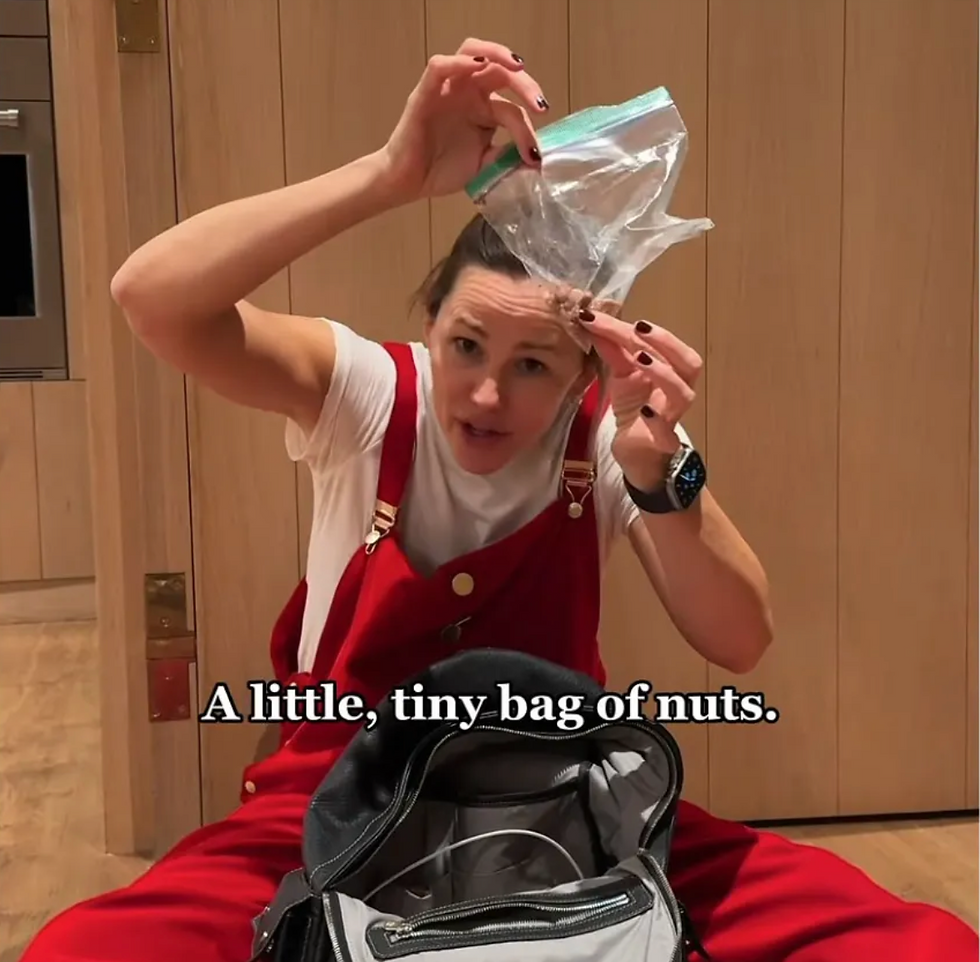
A few weeks later, Jennifer Garner posted a Reel that practically handed us the segue.
There she was, casually pulling what can only be described as an exorbitant amount of nuts from her backpack. Not a normal amount of nuts. Not a responsible “I may need a snack later” amount of nuts.
A comedic amount of nuts.
Which was the point.
The joke was still the joke: an unreasonable quantity of nuts is funny. The difference was that now the internet had supplied the context. Suddenly, the idea did not have to feel random or too edgy. It had a warm, wholesome, celebrity-adjacent cultural doorway.
We would not have had to run the original campaign exactly as pitched. That is not how good social creative works anyway.
We could have pivoted. Softened it. Made it more timely. Made it more wholesome. Let the brand join a cultural moment that was already snack-shaped and waiting.
Hell, we could have sent her a truckload of nuts.
That is the frustrating part. The original “no” did not just kill one idea. It killed the brand’s ability to move when the world handed us a better version of the same lane.
By the time the team could have regrouped, reframed, re-approved, and re-explained why the thing that felt too much three weeks ago now had cultural context, the internet had moved on.
As it does.
Rudely, and without checking the campaign calendar.
And Then Other Brands Made the Joke Anyway
The real kicker is that the world is clearly not above the joke when the right person or brand decides to own it.

Look at Good Nut, the Tom Brady coconut water launch. The name is built around the double-take. It knows exactly what people are going to think, and instead of running from it, the brand leans in.
That does not mean every company should suddenly start naming products like they lost a bet in a group chat.
Please no.
But it does prove the larger point: the joke itself is not always the problem. Sometimes the question is whether the brand has the confidence, timing, and context to make it work.
A nut joke from inside the room can feel risky.
A nut joke with celebrity momentum suddenly feels like strategy.
And maybe sometimes it is.
But if that is true, then brands need to get better at knowing the difference between reckless and memorable.
Because those are not the same thing.
Reckless ignores the audience, the brand, the timing, and the room.
Memorable understands all of those things and still has the nerve to say something with a little shape to it.
Safe Can Still Cost You
The risk conversation in creative work gets very lopsided.
Everyone worries about the joke that might not land. Fair. Nobody wants to be the brand canceled for a nut faux pas. Nobody wants to be the screenshot in a marketing newsletter under the headline, “What Were They Thinking?”
But there is another risk that gets much less attention.
The risk of going so safe, so polished, so approved-by-committee, so aggressively vanilla that nobody remembers you existed.
That is still a risk.
It is just quieter.
A safe campaign can still fail. It just fails politely. It disappears into the feed wearing a nice outfit and sensible shoes.
No one gets mad.
No one remembers it either.
And in some ways, that is worse.
Because if you are launching something new, the goal is not just to avoid complaints. The goal is to create attention, interest, recall, and ideally, some kind of movement toward purchase.
A launch should not just announce that a product exists.
It should give people a reason to care.
Sometimes that reason is usefulness. Sometimes it is beauty. Sometimes it is emotion. And sometimes, yes, it is a joke that makes the product impossible to ignore.
That does not mean every brand needs to become edgy, sarcastic, or terminally online. Some brands should absolutely not be given unrestricted access to memes. We have all seen what happens when a corporate account discovers slang and immediately needs supervision.
But if there is a real product tie-in, a real cultural opening, and a real reason for the brand to join the moment, maybe the answer does not always have to be no.
Maybe the better questions are:
Can we make this smarter?
Can we make this more on-brand?
Can we move quickly enough for it to matter?
Can we make this funny without making legal breathe into a paper bag?
Because sometimes the joke is not the problem.
Sometimes the fear is.

The Launch Could Have Been Louder
This is what I keep coming back to.
The rejected idea was not about being edgy for the sake of being edgy. It was about giving the launch a stronger hook.
A safe launch says, “Here is a new product.”
A better launch says, “Here is why this product belongs in your life, your conversation, your group chat, your snack drawer, your road trip, your tote bag, your absurd celebrity backpack.”
That is the difference between information and momentum.
And yes, not every big swing becomes a home run. Some jokes miss. Some ideas need editing. Some concepts are funny in a meeting and deeply questionable in the wild.
But “go big or go home” exists for a reason. Not because every brand should be loud all the time, but because memorable work usually requires some kind of commitment.
A point of view.
A sharper angle.
A reason to stop scrolling.
A reason to say, “Wait, did you see this?”
That is what the safe version often loses. Not the product information. Not the polish. Not the approval.
The spark.
The thing that makes people feel like a real human was allowed near the campaign.
And when celebrities and other brands later prove that the joke had cultural room to breathe, it is hard not to look back and think: that could have been ours.
That could have been the moment.
That could have been the launch people talked about.
Instead, it became another clean, safe, perfectly acceptable product announcement floating quietly through the feed.
Vanilla.
And not even French vanilla.
Just regular.
Good Ideas Need Room to Move
The goal is not to make brands reckless.
The goal is to make them responsive.
Responsive brands still have standards. They still have guardrails. They still know who they are. But they also understand that culture does not wait patiently while six people align on whether a snack joke feels “ownable.”
Good social creative needs a little room to move.
Not chaos. Not recklessness. Not “the intern posted this at midnight and now legal is astral projecting.”
Just enough flexibility to say, “That’s funny. That’s relevant. Let’s move.”
This one got a no.
Then culture gave it a yes.
By then, the boat had sailed. The joke had nowhere to go. And somewhere out there, a perfectly good nut concept is still sitting in the rejected pile, wondering what could have been.
Dramatic? Maybe.
But if a brand wants to show up in culture, it has to leave a little room for the moment.
And maybe, just maybe, stop treating every mildly funny idea like it is trying to set the building on fire.
A Very On-Theme Snack Break
Since this entire post has become a love letter to missed opportunities, cultural timing, and snack-based creative regret, it only feels right to end with: hey, buy some nuts.
For brainstorming, overthinking, and surviving the phrase “let’s just mention the sale.”


Comments